
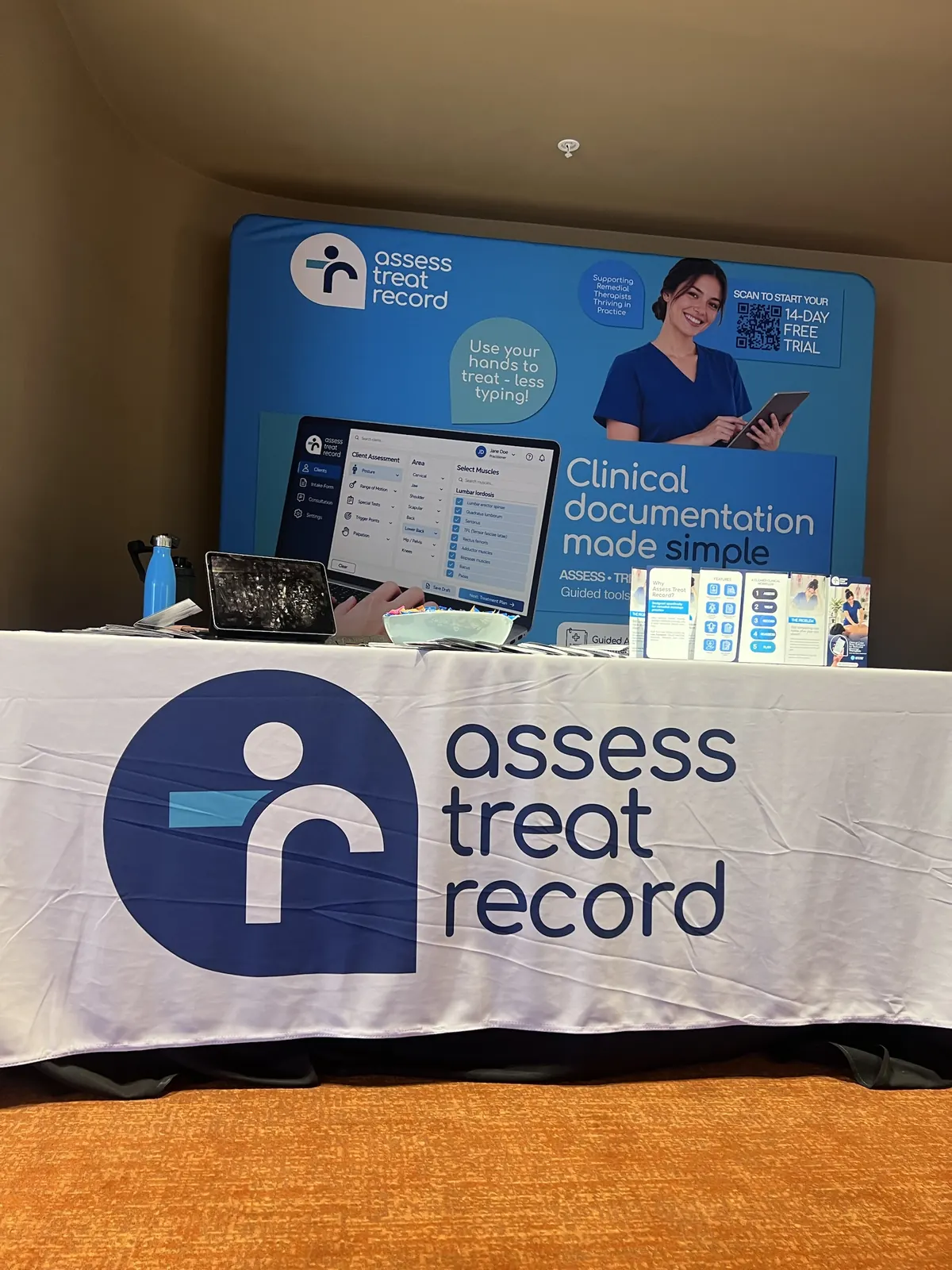
Saturday 10 October 2026 was a special day for me. Alongside attending the AMT annual conference and celebrating the association’s 60th anniversary, I launched Assess Treat Record at the conference.
I’m pleased with how the day went. Bringing something I have worked so hard to develop into a setting dedicated to our profession was a proud milestone.
Built from everyday clinical experience
Assess Treat Record grew from my everyday experience as a clinical remedial massage therapist. I wanted a practical way to document the care we provide, follow a client’s progress and support continuity between appointments.
That idea became a platform built around a familiar clinical workflow:
The message behind it is simple: “Use your hands to treat, less typing.”
For me, that means making documentation more manageable while keeping clinical reasoning and the client’s experience at the centre of our work.
A meaningful place to launch
The conference was a meaningful place to introduce Assess Treat Record. Throughout the day, the talks explored listening, professional standards, individualised care and the development of massage research. These themes connected closely with why I created the platform.
Clear records help us reflect on what we assessed, why we chose a treatment approach, how the client responded and what we plan to do next. They support the work that happens across a series of appointments.
Having the opportunity to talk with fellow therapists about Assess Treat Record made the launch especially meaningful. It brought the project into the professional community it was created to support.
Listening, learning and looking ahead
Launching Assess Treat Record while also listening and learning made the day particularly valuable. It reminded me that developing a tool for therapists needs to remain connected to everyday practice and the people who will use it.
As a practising therapist and founder, I want to keep listening, learning and improving Assess Treat Record so it remains useful in real remedial massage settings.
A small correction and apology
I also want to clarify something I said when speaking with a couple of people at the conference. I mixed up the requirements for receipts with those for clinical case notes. Paper case notes can still be used; I should not have suggested that electronic case notes are compulsory.
My comment about paper receipts also needs to be checked against the relevant health fund’s requirements, rather than stated as a rule that applies everywhere.
My apologies to anyone I confused, and thank you for the conversations that prompted me to clarify this.
Assess Treat Record offers a digital option for practitioners who want a more structured way to manage their clinical documentation. Each practitioner still needs to choose a recordkeeping approach that meets their professional obligations and practice needs.
Thank you
Thank you to AMT for bringing our profession together and creating the setting for this milestone, and to everyone who took the time to speak with me.
I’m proud to have shared Assess Treat Record at the conference and excited about its next chapter.
Explore Assess Treat Record at assesstreatrecord.com.